by Cathy Gilmore | Dec 28, 2016 | RootsTech 2016
If you’ve followed Kindex for very long, you’ll know that we frequently post about our Grandma Dorothy Smith Clark. Today I want to share with you why her story is so important to us.
As a child, I asked Grandma Clark what she would like for her birthday. “Tell me a story,” she answered. This voice speaks to me still. As a young teenager she encouraged me to create and write. A visit with her hardly went by without her suggesting, “Write me a poem.” That encouragement speaks to me still. Today, when I read her letters and diaries, I see her notes in the margins revealing instructions for a personal history—a project she never completed before passing away. Those notes speak to me still.
A marked-up page from Dorothy’s life history.
When my cousin Kimball and I decided to launch Kindex, our aim was to create a solution for the enormous body of work our grandma left behind. While it was impossible for Dorothy to envision the type of indexing tool we are building today, I like to think she had a sense of what was to come. She had the gift of foresight, the ability to anticipate and address needs. In a sense, building Kindex will finish the work she started, while also helping us tell her story.
And what is her story? I’ll share just a part. While still a young mother, Dorothy completed her Book of Remembrance. A work of art in its own right, its pages reveal her deep sense of ancestral belonging, records of her parents’ and grandparents’ spiritual gifts, and a recognition of her own divine purpose and talents. As Dorothy developed her own spiritual gifts, her ability to discern the needs of others and act in faith became a catalyst for ministering to others, notwithstanding the fear and shyness she often felt. To the question posed to the Savior, “Who is my neighbor?” Dorothy could answer: the plumber, the piano tuner, the refugee, or the outcast—anyone in her path in need of help.
A watercolored page from the Dorothy Smith Clark Book of Remembrance
Dorothy’s 1964 poster sketch titled “We Believe in Sharing” affirmed the scope of her desires: to give all she had—her talents, testimony, labor, food, and possessions, bringing “more happiness, enrich[ing] the world, sharing all that has come to us as a church and as individual members.”
[1] Often overcome with social anxiety or limited by her heath, Dorothy preferred personal visits to projects, created art to share the gospel, and wrote hundreds of inspired letters that today stand as a witness to bear one another’s burdens. Without prejudice or judgment, her nurturing influence reached beyond her own nine children when she became a foster mother to two Navajo children and a personal advocate for many Southeast Asian refugees who affectionately called her “Mother Clark”.
Dorothy Clark with husband Ellsworth, foster son Cody Black, and Cody’s family.
While Dorothy’s art was never exhibited, her painting of Paul Wildhaber’s “The Armor of Righteousness” was the centerpiece of her home. Unlike others who traditionally depicted male religious figures, 20-year-old Dorothy changed the painting’s subject from hero to heroine, thus broadening the view of those who are “armed in righteousness”. From her childhood fairy gifts to the ministering of the needful and forgotten, her visionary example of what a woman can do endures through her depiction of this righteous and strong heroine.

Dorothy Smith in Paul Wildhaber’s studio.

Dorothy Smith’s completed “Armor of Righteousness”
Dorothy continued her talent of creating and sharing family histories well into the last years of her life. In 1980 she participated in the World Conference of Records in a booth of her own design.
Dorothy at the World Conference of Records in 1980
As I think about her life, I see a patterns emerging as her children, grandchildren, and beyond strive to finish what she started. Kindex is just a small part of a larger effort to emulate the kind of woman she was. Sometimes, when I feel overwhelmed at the pressures of launching a startup while still raising a young family, I look at the binders and boxes of her records and think, “Soon, we’ll know your story. Not long yet.”
Dorothy and Ellsworth in New Zealand, 1974
[i] Dorothy Smith, Sketches. “We Believe in Sharing”, 1964

by Cathy Gilmore | Jun 18, 2016 | Uncategorized
I have looked at enough census records to know that the center column—the occupation—is where much of the lives of my ancestors are revealed. While many researchers take pride in a discovery of distinction—a gentleman perhaps, or a minister, doctor, or politician—I have yet to strike gold in a vein of worldly merit. Rather, as I have turned back to my fathers and mothers, I have found them laboring in the trades of the lower class as fisherman, farm laborers, gardeners, maids, and most frequently, general laborers. It is this last title of general laborer that has caused me to reflect on the merits given to the poor, unskilled, and weary. I picture the enumerator, peering up from his broad census sheet, quill poised. Occupation? Laborer.
 What more do we know of some of our laborers? My fifth great grandfather, a farm laborer in Essex, died of “sloughing of the foot”, leaving behind ten children. My husband’s family worked in the damp fields of Northern England. Such laborers did not receive payment for their work until after their term of hire was completed. Poor and hungry, they ate raw turnips in the fields to stave their hunger.
Our laborers were not always virtuous. My third great aunt Ellen Chamberlain was brought to trial for stealing two loaves of bread. Trial notes reveal when confronted, “she then took the loaf from under her shawl and said “This is the loaf—pray, sir, forgive me.” For this she was given two months hard labor, a sentence of apparent leniency. My fifth great grandfather Ben Chamberlain was relieved from his apprenticeship in 1785 due to “disorderly behaviour and frequent absences”. Rumors abounded of drinking and ill tempers, an apparent occupational hazard of our ship laborers.
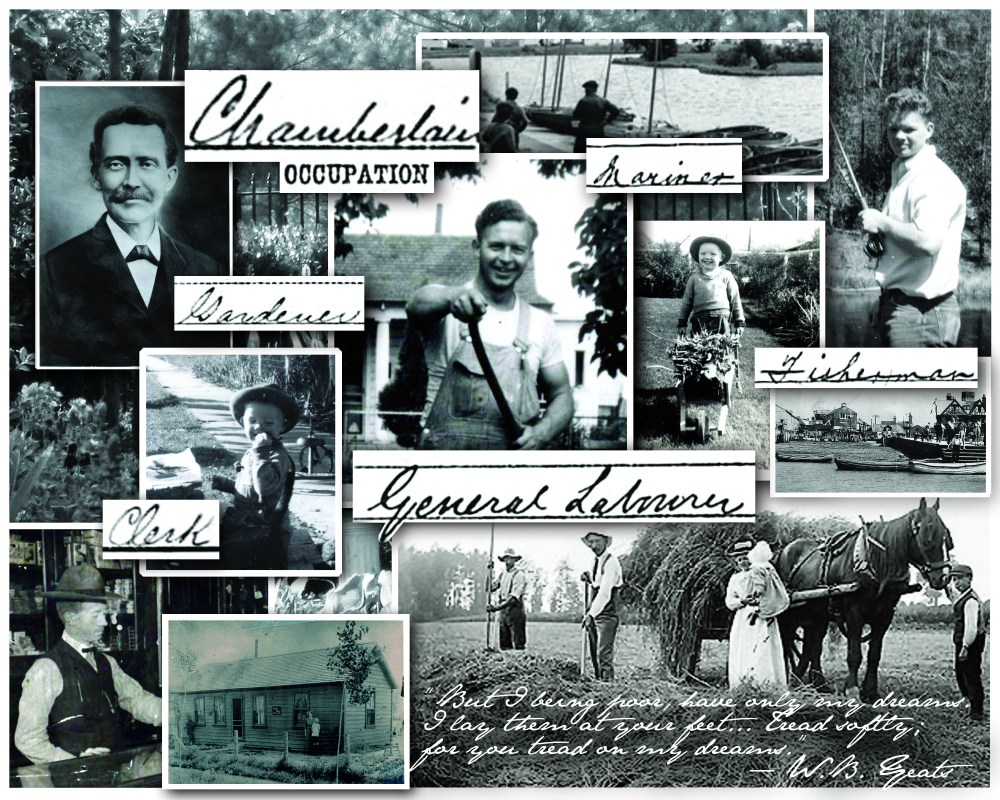
Then there were the deaths, inexplicable and beyond comprehension. My sixth great uncle was a farm laborer and father of eleven children; all of his children died in childhood save two. When my third great aunt was pregnant with their first child, her husband Edward Austin worked as a laborer in a neighboring town. While he was digging a ditch when a man nearby leaned his rifle against a tree. The rifle fell and fired accidentally, mortally wounding the young father-to-be. Most of our fathers were taken young. Looking back six generations down to my grandfather, all passed in their 30’s or 40’s with the exception of two.
And the women? What is not written can only be imagined. They suffered ill-timed relationships and abandonment, and worked as maids, nurses, and farm laborers at tender ages. Many did not rest in their old age, working as cleaning women or doing laundry.
When our Chamberlain family reached New York City in 1888, there could not have been a more obscure family with more dubious health and almost no wealth. When they arrived in Salt Lake City a few weeks later, they were taken to the Tithing Yard for needed food and supplies. It was there on a bale of hay that their infant son Robert died, a pained and mournful offering in the midst of others sacrifice. A few months later, his mother Ellen Gardner Chamberlain died from tuberculosis.
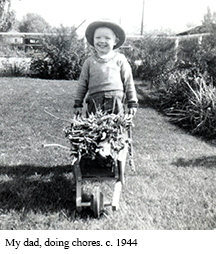
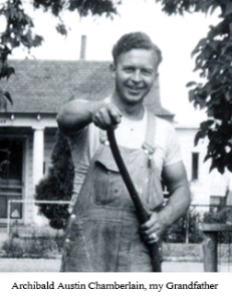 Their grandson—my grandfather—was also laborer. His forearms—as wide as melons and too large for sleeves—have found a place in me. He taught his son—my father—how to build, paint, and care for a home and yard. Once my mother famously waited for my dad for a date while he finished the lawn: mow twice, once in each direction, then rake and bag the grass.
My own body and soul bears the traces of the laborer. My legs, large and strong as rocks, have carried my children up mountains and pushed me down miles of roads. I have strong hands arms like my fathers before me, that can open jars and till gardens. I have inherited a willingness to work—to jump, climb, shovel and lift. While my stomach has never soured from raw turnips, or my coat hidden bread, my blood carries the virtues and flaws of the laborer. My face reveals the crease of worry, my clothes show stains of earthly chores, my skin maps the scars of adventure and my soul the ache of every weakness.
 When I die, don’t list my jobs; just write General Laborer under my name—this title I tenderly share with those laborers who have gone before me. To achieve such a distinction as this would be to have prepared myself in all things, to have worn out my body and mind completely, to have worked as they worked, so as to meet them on level ground.