
by Cathy Gilmore | Sep 19, 2018 | Features
Kindex Co-founder Cathy Gilmore presented “Hoarder to Order: a Step-by-Step Family Record Rescue” at RootsTech 2018. This presentation examines why records are at risk, discusses obstacles to family record preservation, and gives a step-by-step overview of how record-keepers can rescue their family records. We will be sharing excerpts from her presentation on the Kindex blog.
Part I: Am I my Brothers (Record) Keeper?
Part II: A Family Record Risk Assessment
Now that we’ve discussed the important role of record-keepers, and what risk factors help us prioritize our record rescue, we are finally ready to begin a record rescue in earnest. Put very broadly, here are the basic steps of the record rescue.

Before a single record is gathered, scanned, or indexed, we must prepare for the rescue by asking a few important questions. The first: What is your Why?

Establishing your “why” is a crucial step, because it’s a reason you will turn to again and again. Record rescuers will face countless challenges, face adversity, and experience burnout (and that’s just the first week!). Your “why”” will inspire you and others stay focused on the goal more than a “what” ever could.
Knowing your “why” will help you visualize what you want to have happen as a result of your record rescue. Your “why” can be specific or broad, tangible or intangible. Here are some examples:
- “I want my family to know who my grandmother was”
- “I want to ensure my Great-Grandfather’s influence will be felt for generations”
- “I want to help future researchers and historians”
- “I want my father to be remembered”
- “I want to change the hearts of my family”

Now that you’re thinking about your “why”, let’s also think about the “what”. The “what” is the scope of your record rescue. Your scope should answer these questions:
Who? Which? What? When?
In other words:
- Whose records are we rescuing?
- Which records are included?
- What are we doing to the records?
- When will we complete it?
For example:
- We are scanning grandma’s love letters by Christmas! (not photos, not greeting cards, not family letters)
- We are gathering all of the family records pertaining to Aunt Betty before she moves into her new home.
Advice on Scope
- Start small. You wouldn’t climb a mountain pulling a mountain of 15 boxes, but you could take a backpack. That’s actually a good rule of thumb: can you fit your record rescue in a backpack? If the answer is no, consider paring down the scope into something with reasonable, reachable boundaries.
- If possible, separate records based on record type. For example, rescuing grandma and grandpa’s love letters is easier when you don’t include t photos, slides, and diaries. The more record types you have, the more complex your project will be, especially during the scanning and preservation stages.
- Show success early and often. Keep your family engaged in the rescue by updating them on your progress and sharing records on social media.
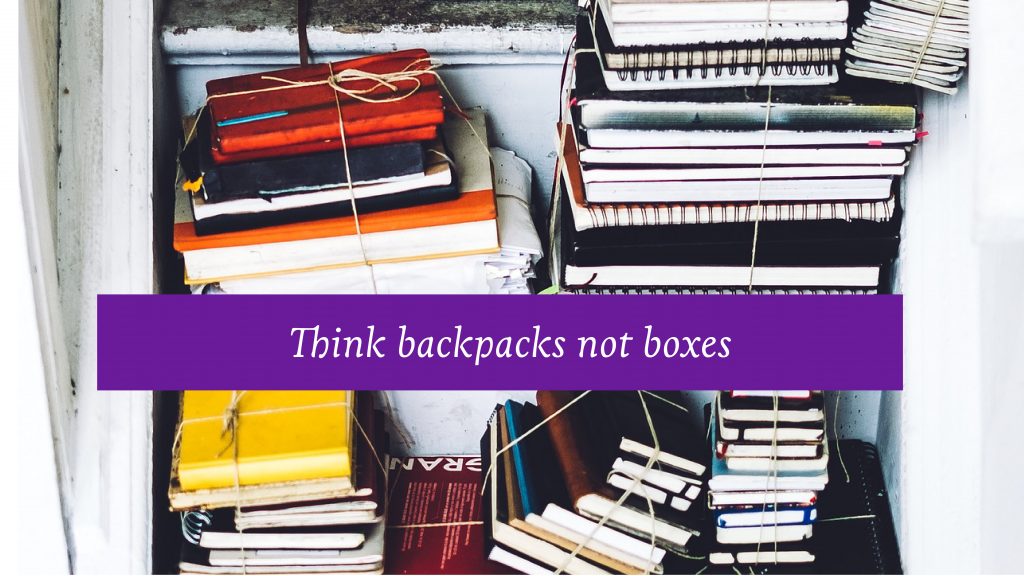
In addition to knowing our “why” and “what”, there is one more step in our record rescue preparation: enlisting help. Stay tuned for our next installment where we discuss ways to engage your family in the rescue.

by Cathy Gilmore | Sep 10, 2018 | Features
Kindex Co-founder Cathy Gilmore presented “Hoarder to Order: a Step-by-Step Family Record Rescue” at RootsTech 2018. This presentation examines why records are at risk, discusses obstacles to family record preservation, and gives a step-by-step overview of how record-keepers can rescue their family records. We will be sharing excerpts from her presentation on the Kindex blog.
In Part I of our Hoarder to Order series, we asked “Am I my Brothers (Record) Keeper?” and discussed the imporant role of family record rescuers. If you are one of those heroes committed to rescuing records, it may be difficult to know where to start. Knowing the risks that face family records helps us prioritize and understand what it means to truly rescue a record. Let’s start by stating the risks, identifying reasons why this happens, and how we can help.
Risk #1: Permanent Record Loss
Risk Factors
|
Result
|
How We Rescue
|
| Death Downsizing Relocation Record owner has mental or physical challenges |
Records are thrown out |
Take an inventory of family records to know who has what |
Let’s start with every record-keeper’s biggest nightmare right out of the gate: Records get thrown away. This risk is at its greatest when a family member dies, moves, or is purging their belongings. The presence of mental or physical challenges can often prevent record owners knowing how to keep and care for records. As a record rescuer, your job is to discover who has what records through conducting a basic inventory. Conducting a family record inventory is the first, crucial step in a record rescue. But what are the remaining risks?
Risk #2: Temporary Record Loss
Risk Factors
|
Result
|
How We Rescue
|
| Changes of record ownership (records passed down through generations) Hoarding, disorganization |
Records are lost or misplaced |
Update inventory & gather records (where possible) |
If you’ve kept your family record inventory updated, and gathered records (where possible) to prevent record loss, well done! But what are the remaining risks?
Risk #3: Record Damage
Risk Factors
|
Result
|
How We Rescue
|
| Records exist in original state only (not scanned or digitized) Improper storage or handling Records are exposed to, or at high risk for natural disaster (fire, flood, etc.) |
Records are damaged |
Digitize records and ensure physcial reocrds are properly stored |
So you’ve done an inventory, gathered records to prevent record loss, and digitized your records. Great! Is your job done? What are the remaining risks?
Risk #4: Inaccessible records
Risk Factors
|
Result
|
How We Rescue
|
| Records scattered among multiple owners Single owner, “Silo mentality” Donated with restrictions |
Records can’t be accessed |
Share digitized records on common platform |
Most responsible record-keepers have digitized their records. But how accessible are they? Do you work in a silo? How do other family members know your records exist?
If uou’ve kept your records, know where they are, scanned them, and made them accessible, are there any other risks? We’ve learned that making records accessible is not the end of the line. If your family cannot easily connect to and share records, there will be a record disconnect.
Risk #5: Record disconnect
Risk Factors
|
Result
|
How We Rescue
|
|
Unindexed records
Records that seem irrelevant, unimportant
Records in unsearchable, undiscoverable databases
Records that are handwritten or hard to read Difficulty extracting meaningful stories
|
Records Disconnect |
Transform your records in ways that make them shareable and connectable.
Make records completely searchable Provide a platform for simple record engagement and research
|
What is record disconnect, and why is it a risk? Because no matter how much work you put into gathering, digitizing and sharing records, if your family can’t connect with them in a meaningful way, they will remain unimportant and therefore at risk of being perpetuated. When is a record truly considered rescued? When it’s accessible, searchable, and relevant to your family.
How at risk are your family records?
In reviewing risk factors for family records, have you identified what records are most at risk in your family? Do you have an elderly family member reputed to have many family records. Is someone in your family preparing to downsize? Being aware of family situations helps us prioritize an overwhelming task by beginning where the need is most urgent. Stay tuned for Part III of our Hoarder to Order series, we will start our record rescue in earnest with record inventory and gathering.

by Cathy Gilmore | Mar 11, 2018 | Features
Kindex Co-founder Cathy Gilmore presented “Hoarder to Order: a Step-by-Step Family Record Rescue” at RootsTech 2018. This presentation examines why records are at risk, discusses obstacles to family record preservation, and gives a step-by-step overview of how record-keepers can rescue their family records. We will be sharing excerpts from her presentation on the Kindex blog.
Most of you will recognize this young woman as Anne Frank, the young Jewish girl who kept a diary while in hiding from the Nazis during World War II. Her diary provid a vital, personal voice to the war experience and went on to become literary and historical treasure.

Anne Frank, c1940. Unknown photographer; Collectie Anne Frank Stichting Amsterdam – Website Anne Frank Stichting, Amsterdam
Do you recognize this woman?
Hermine Santruschitz, also known as Meip, was among those who helped Anne Frank and her family hide in the annex during World War II. Her service to the Frank family continued after the war when she retrieved Anne’s diary from the annex and took the diary to Anne’s father, Otto, the only surviving member of the Frank family. Anne was the record creator, but Meip was the record rescuer. Without Meip, Anne’s story could have been lost to history.
Many of us are the “Meips” of our family: we are the record rescuers. While we do not face the same obstacles as the Frank family, we have a great responsibility to ensure our family records are not lost, damaged, or thrown away. As keepers of family records in an increasingly digital age, we are among the last generations who will create or save written family records. Stored in boxes or on closet shelves, our records are not just the museum pieces of the future—they are the ultimate key to our family history, the tablula rasa that coming generations will turn to for answers.
Which leads us to the question: Am I my brother’s (or grandmother’s, or uncle’s, or cousin’s) record keeper? We must be. As the gatekeepers of family records, how do we fulfill our responsibility to rescue them and preserve both our family’s legacy and add their voices to history? From boomers to millennials, we bear the collective responsibility to rescue history through our family records.
How do we begin? From inventory, to scanning, to digital archiving, each step of a record rescue could easily be (and probably is) a class of its own. It can be overwhelming, but there is hope. The purpose of this series make a family record rescue manageable, give tips for success, and inspire each of you to take action.
Next up: Hoarder to Order Part II: A Family Record Risk Assessment. We will discuss why family records are at risk and review common obstacles families face in record-keeping and preservation.

by Cathy Gilmore | Jul 11, 2017 | Features
Every family has at least one. No, not the crazy uncle. We’re talking about the record-keepers. You know, the ones that ended up with all the stuff: the family bible, the old photos, the diaries and letters. Some people spend a lifetime gathering records, hoarding photos, and hunting down lost items. Others come upon records by accident or inheritance. If you’re a record keeper, chances are you’ve thought a lot about what to do with your family records. You may not know it, but you’re an archivist.

What’s in Your Closet?
Like professional archivists, your goal is to collect, preserve, and share things—in your case, family records. Among the challenges professional archivists face when building a digital repository is making their collections discoverable, accessible, and searchable to their patrons. Family archives share these same challenges. For record-keepers of family photos, journals, letters, and other precious memorabilia, we should think like an archivist and ask ourselves the following three questions about our family records.
1. Are they discoverable?
Do your relatives and researchers know your family records exist? If not, how would they discover them? If your records are not “born digital” and are still in their original state as paper letters, journals, and other documents, it’s nearly impossible for others to discover your records. If your records are digitized, where are they stored? For example, the storage options below have varying levels of discoverability.
- Cloud storage, like Google Drive, One Drive, Dropbox
- Physical storage, like computers, external hard drives, USB, CDs, etc.
- Online family tree databases, like FamilySearch, MyHeritage, and Ancestry
- Historical or genealogical archives
While some may think “I don’t want my records to be discovered,” remember that discoverability does not preclude archive owners from establishing rules of access and usage. For example, record owners may wish to be selective with record sharing, charge for record access, or enable rules and limitations on the use of the record. No matter what rules we have in place, discoverability remains the fundamental first step in creating a family archive. Without it, our records are lost to the world.
2. Are they accessible?
Once records are discovered, can relatives and researchers access them? There are many instances where records may be discoverable, but not accessible. For example:
- You discover records online, but they are in a private family tree you can’t gain access to
- You discover that a record in an archive, but it can only be accessed by visiting the archive
- You discover a record in an archive, but learn that access is limited to certain people
- Everyone knows Aunt Sue has the family Bible, but she won’t show it to anyone
- Your relative has the family photo collection on his external hard drive, but you can’t get a copy
As a record-keeper and family archivist, an important role is to enable accessibility to family records. If you don’t do it, who will?
3. Are they searchable?
Are your family records currently searchable? How easily are they sorted, searched, and read? What elements of your records are searchable (file names, titles, descriptions, etc.)? How does your software, cloud storage, or family tree database facilitate searchability? As a companion question, can your records (and all of their associated data) connect with other databases, family trees, and archives? Furthermore, can your record data be downloaded, manipulated, and applied in other ways, like timelines, maps, and books? When choosing where to place your family records, remember that full searchability is key to an archive that is engaging, connectable, and readable.
 A Kindex Solution
These are the kinds of questions we think about every day. We help family archivists rescue their records, bring them out of obscurity, and create archives that can be discovered, accessed and shared. With Kindex you can:
- Enable your archive to be discovered by potential collaborators and contributors
- Access your archive from any computer, anywhere.
- Unite scattered family records, make hard-to-find collections accessible to your members, and create public or private networks to collaborate on your archive
- Create searchable record data in three ways (metadata, full text transcription, and tags)
- Download your archive data (as CSV) any time.
In addition, we have some amazing features presently in development that will help your archive to connect and be shared with other people in various formats.
SAY NO MORE. LET’S DO THIS!
Still undecided? Here are some bonus questions:
|
Where is your Archive?
|
|
Undigitized |
On your computer |
In cloud |
In a digital family tree |
On Kindex |
| Do I control my archive access, scope, and content? |
Yes |
Yes |
Yes |
Varies (private vs. wiki-based) |
Yes |
| Is my archive discoverable online? |
No |
Limited |
Limited |
Varies (private vs. wiki-based) |
Yes |
| Is my archive accessible from any computer? |
No |
Very limited |
Varies |
Varies |
Yes |
| Can others collaborate on my archive |
No |
No or very limited |
Yes; limited |
Varies |
Yes |
| Can my archive be private? |
Yes |
Yes |
Varies |
Varies |
Yes; Choose your privacy level |
| Is my archive fully searchable? |
No |
Limited |
Limited |
Limited |
Yes* |
| Can I add metadata? |
Yes |
Varies |
Varies |
Limited |
Yes |
| Can I add metadata in batch form? |
No |
No |
No |
No |
Yes |
| Does my archive have integrated transcription & record tagging tools? |
No |
Varies; often separate from primary source |
Rare; Varies by platform |
Rare; Varies by platform |
Yes |
| Can I download all my archive data? |
No |
No |
No |
No |
Yes |
| Is my archive compatible with other databases? |
No |
Varies |
Varies |
Varies |
FamilySearch (others forthcoming) |
*some metadata searchability in development
Archive Your Life on Kindex
Don’t you think it’s time you started thinking like an archivist? Kindex is free to try, so head over to Kindex.org and get started. Click “Try it Out” to start your free archive up to 50 records. Upgrade to unlimited records (and unlimited collaborators!) for about $12/month.
TRY IT OUT!


by Cathy Gilmore | Apr 6, 2017 | Features, Resources, Software
Among the many documents our Grandma Dorothy Clark left behind was a handwritten list of her attempts to be published. She sent articles to church magazines or the Reader’s Digest, but not once were her stories published. As an amateur artist, she never had an exhibit of her art beyond the walls of her own home except the occasional entry at the State Fair. And her letters—including hundreds of handwritten letters to family & friends—sat folded up in boxes for years.

Dorothy Smith in Paul Wildhaber’s art studio in Salt Lake City, Utah, 1932
Her amazing life never made headlines, and was never published. Her records are not found in any special collection, or any other archive devoted to preserving government, academic, or historical records. Her records live on our shelves and closets. But to us she was a leader worth following, and a woman worth remembering. She deserves an archive.
Your Records At Risk
What about your records? Family records represent one of the most at-risk sources of our history. One only has to walk through flea markets and second-hand stores to see the plethora of family records that are discarded. Records that are kept are often scattered among various families, eventually getting lost, damaged, or forgotten.
How will you ensure this doesn’t happen to your records? Do your photos, journals, diaries, letters, and other precious family records deserve an archive? Another way of asking that question is, “Do you deserve to be remembered?”. The answer is, of course “Yes. A thousand times yes.”

Everyone deserves an archive—not just the rich, famous, or important. We all deserve to be remembered.
Searchable Archives for Everyone
When we built Kindex, our goal was to bring amazing archival tools to everyday families. Putting family records on Kindex enables anyone to create a digital archive and access professional tools that make their records more accessible and relevant than ever. Families who manage their own archives on their custom Kindex subdomain can:
- Collaborate with unlimited people to gather records from multiple sources
- Add unlimited records
- Import and add metadata in batch mode (release April 10 2017)
- Utilize crowdsourced indexing tools
- Choose public or private archive access
- Enjoy full text searchability
- Access & download source records and indexed data
Cool. How do I start?




.jpg)
